
Deploy a WAF managed ruleset in the dashboard
The instructions in this page provide general guidance for deploying and configuring a managed ruleset for a zone.
For more specific instructions, refer to the following pages:
- Deploy the Cloudflare Managed Ruleset
- Deploy the Cloudflare OWASP Core Ruleset
- Deploy the Cloudflare Sensitive Data Detection ruleset
To deploy a managed ruleset for a zone:
-
In the Cloudflare dashboard, go to the Security Settings page.
Go to Settings -
(Optional) Filter by Web application exploits.
-
Turn on the managed ruleset(s) you want to deploy:
- Cloudflare managed ruleset - Deploys the Cloudflare Managed Ruleset.
- OWASP Core - Deploys the Cloudflare OWASP Core Ruleset.
- Sensitive data detection - Deploys the Cloudflare Sensitive Data Detection managed ruleset.
-
Review the deployment settings. Edit the scope, if necessary, to apply the ruleset to a subset of the incoming requests, or configure any custom settings (also known as overrides).
-
Select Save.
-
Log in to the Cloudflare dashboard ↗, and select your account and domain.
-
Go to Security > WAF > Managed rules tab.
-
Under Managed Rulesets, select Deploy next to a managed ruleset.
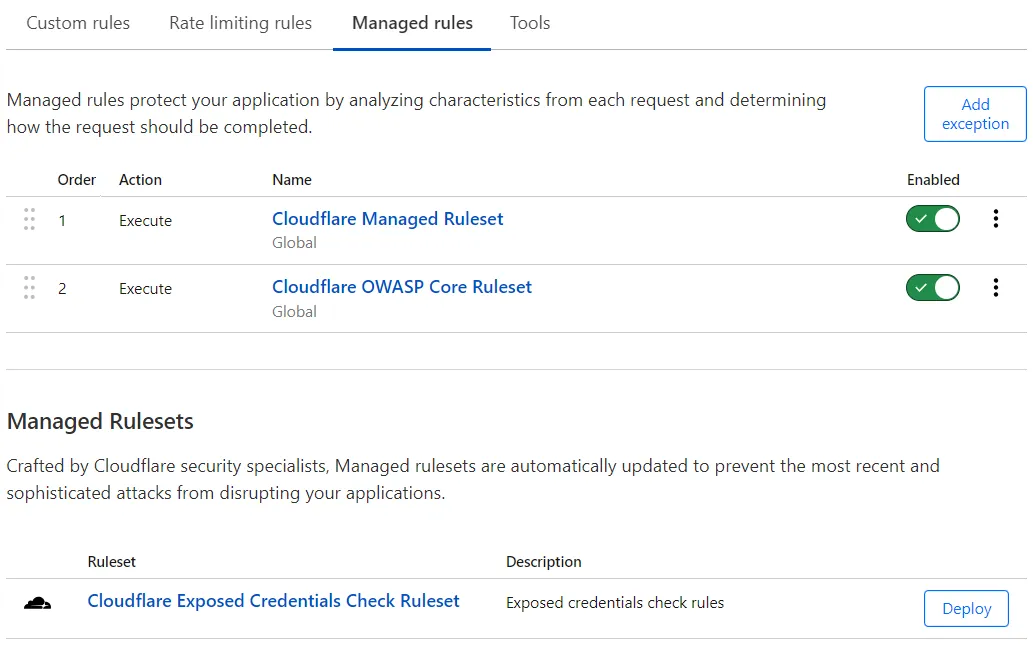
This operation deploys the managed ruleset for the current zone, creating a new rule with the Execute action.
To temporarily turn off a managed ruleset without deleting its deployment configuration, use the toggle next to the rule that deploys the managed ruleset.
Configure a managed ruleset to:
- Specify a custom filter expression to apply the rules in the ruleset to a subset of incoming requests.
- Configure (or override) specific settings for one or more rules (for example, configure a rule with an action different from the default action configured by Cloudflare), or turn off those rules.
To skip one or more rules — or even entire managed rulesets — for specific incoming requests, add an exception.
To configure (or override) settings for all the rules in a managed ruleset:
-
In the Cloudflare dashboard, go to the Security rules page.
Go to Security rules -
(Optional) Filter by Managed rules.
-
Search for the managed ruleset you want to configure. Look for a rule with an Execute action.
-
Select the rule name (containing the name of the managed ruleset) to open the deployment configuration page.
-
(Optional) To execute the managed ruleset for a subset of incoming requests, select Edit scope and configure the expression that will determine the scope of the current rule deploying the managed ruleset.
-
In the ruleset configuration section, define settings for all the rules in the ruleset by setting one or more fields using the drop-down lists.
For example, select the action to perform for all the rules in the ruleset.
-
Select Save.
-
Log in to the Cloudflare dashboard ↗, and select your account and domain.
-
Go to Security > WAF > Managed rules tab.
-
Next to the Execute rule deploying the managed ruleset you want to configure, select the managed ruleset name.
If you have not deployed the managed ruleset yet, select the managed ruleset name under Managed Rulesets. -
(Optional) To execute the managed ruleset for a subset of incoming requests, select Edit scope and configure the expression that will determine the scope of the current rule deploying the managed ruleset.
-
Under Ruleset configuration, define settings for all the rules in the ruleset using the drop-down lists.
For example, select the action to perform for all the rules in the ruleset.
-
If you have not deployed the managed ruleset yet:
- Select Deploy to deploy the ruleset immediately.
- Select Save as Draft to save your deployment settings for later.
If you are editing a managed ruleset you already deployed, select Save.
To configure (or override) settings of rules tagged with specific tags:
-
In the Cloudflare dashboard, go to the Security rules page.
Go to Security rules -
(Optional) Filter by Managed rules.
-
Search for the managed ruleset you want to configure/browse. Look for a rule with an Execute action.
-
Select the rule name (containing the name of the managed ruleset), and then select Browse rules.
-
Select one or more tags under the search input to filter the rules with those tags, and then select the checkbox in the top left corner of the table to select all the rules shown in the current page.
If not all the rules are displayed in the current page, extend your selection to all rules with the selected tags across all pages by selecting Select all <NUMBER> rules. -
Update one or more settings for the selected rules using the buttons displayed in the top right corner of the table (for example, Set status).
-
Select Next.
-
A dialog appears asking you if any new rules with the selected tags should be configured with the field values you selected.
- Select Include new rules if you want to apply your configurations to any new rules with the select tags.
- Select Only selected rules to apply your configurations to the selected rules only.
-
Select Save.
-
Log in to the Cloudflare dashboard ↗, and select your account and domain.
-
Go to Security > WAF > Managed rules tab.
-
If you have already deployed the managed ruleset you want to configure, select the ruleset name in the list of deployed managed rulesets. Alternatively, select the three dots > Edit next to the Execute rule deploying the managed ruleset.
If you have not deployed the managed ruleset, select the ruleset name under Managed Rulesets.
-
Select Browse rules.
-
Select one or more tags under the search input to filter the rules with those tags, and then select the checkbox in the top left corner of the table to select all the rules shown in the current page.
If not all the rules are displayed in the current page, extend your selection to all rules with the selected tags across all pages by selecting Select all <NUMBER> rules. -
Update one or more settings for the selected rules using the buttons displayed in the top right corner of the table (for example, Set status).
-
Select Next.
-
A dialog appears asking you if any new rules with the selected tags should be configured with the field values you selected.
- Select Include new rules if you want to apply your configurations to any new rules with the select tags.
- Select Only selected rules to apply your configurations to the selected rules only.
-
Select Save.
To configure (or override) settings of individual rules of a managed ruleset:
-
In the Cloudflare dashboard, go to the Security rules page.
Go to Security rules -
(Optional) Filter by Managed rules.
-
Search for the managed ruleset you want to configure/browse. Look for a rule with an Execute action.
-
Select the rule name (containing the name of the managed ruleset), and then select Browse rules.
-
Search for rules using the available filters.
-
In the results list, change the values for each rule as desired, using the displayed drop-down lists and toggles. For example, change the status of a rule using the Status toggle next to the rule.
To configure multiple rules with the same value, select the checkboxes for all the rules you want to configure. If not all the rules are displayed in the current page, you can extend your selection to all rules across all pages by selecting Select all <NUMBER> rules. Then, use the buttons displayed in the top right corner of the table — for example, Set status — to update one or more fields for the selected rules.
-
Select Next, and then select Save.
-
Log in to the Cloudflare dashboard ↗, and select your account and domain.
-
Go to Security > WAF > Managed rules tab.
-
If you have already deployed the managed ruleset you want to configure, select the ruleset name in the list of deployed managed rulesets. Alternatively, select the three dots > Edit next to the Execute rule deploying the managed ruleset.
If you have not deployed the managed ruleset, select the ruleset name under Managed Rulesets.
-
Select Browse rules.
-
Search for rules using the available filters.
-
In the results list, change the values for each rule as desired, using the displayed drop-down lists and toggles. For example, change the status of a rule using the Status toggle next to the rule.
To configure multiple rules with the same value, select the checkboxes for all the rules you want to configure. If not all the rules are displayed in the current page, you can extend your selection to all rules across all pages by selecting Select all <NUMBER> rules. Then, use the buttons displayed in the top right corner of the table — for example, Set status — to update one or more fields for the selected rules.
-
Select Next, and then select Save.
You can browse the available rules in a managed ruleset and search for individual rules or tags.
-
In the Cloudflare dashboard, go to the Security Settings page.
Go to Settings -
(Optional) Filter by Web application exploits.
-
Find the managed ruleset you want to browse, and select View ruleset.
-
Review the rules and their tags in the side panel.
-
Log in to the Cloudflare dashboard ↗, and select your account and domain.
-
Go to Security > WAF > Managed rules tab.
-
If you have already deployed the managed ruleset you want to configure, select the ruleset name in the list of deployed managed rulesets. Alternatively, select the three dots > Edit next to the Execute rule deploying the managed ruleset.
If you have not deployed the managed ruleset, select the ruleset name under Managed Rulesets.
-
Select Browse rules.
-
In the Cloudflare dashboard, go to the Security rules page.
Go to Security rules -
(Optional) Filter by Managed rules.
-
Search for the managed ruleset you want to configure.
-
Next to the managed ruleset deployment rule (execute rule) or exception (skip rule) you want to delete, select the three dots > Delete and confirm the operation.
- Log in to the Cloudflare dashboard ↗ and select your account and domain.
- Go to Security > WAF > Managed rules tab.
- Next to the rule or exception (skip rule) you want to delete, select the three dots > Delete and confirm the operation.