
Post-quantum cryptography in Cloudflare One
Cloudflare One replaces legacy corporate security perimeters with Cloudflare's global network, making access to the Internet and to corporate resources faster and safer for teams around the world.
Organizations can obtain end-to-end post-quantum encryption of their private network traffic by sending it over Cloudflare One's post-quantum on-ramps and off-ramps. This protects traffic with post-quantum encryption to prevent harvest-now, decrypt-later ↗ attacks, even if the individual applications are not yet upgraded to post-quantum encryption. In a harvest-now, decrypt-later attack, an adversary harvests data now and decrypts it in the future, when more powerful quantum computers come online.
Post-quantum encryption is offered in all major Cloudflare One network configurations, including the following on-ramps:
- Clientless (browser-only)
- Cloudflare One Client (on the end-user device)
- Cloudflare IPsec on-ramp
And off-ramps:
- Cloudflare Tunnel off-ramp (using
cloudflared) - Cloudflare IPsec off-ramp
For traffic that egresses to the public Internet, Cloudflare Gateway also provides post-quantum encryption as a Secure Web Gateway (SWG).
All of these network configurations use the post-quantum key agreement algorithm ML-KEM-768 deployed alongside classical Elliptic Curve Diffie-Hellman (ECDH), where the symmetric key used to encrypt network traffic is derived by mixing the results of the ML-KEM key agreement and the ECDH key agreement. This is also known as hybrid ML-KEM. In this hybrid approach, ML-KEM provides protection against quantum harvest-now, decrypt-later attacks, while ECDH provides protection against non-quantum adversaries.
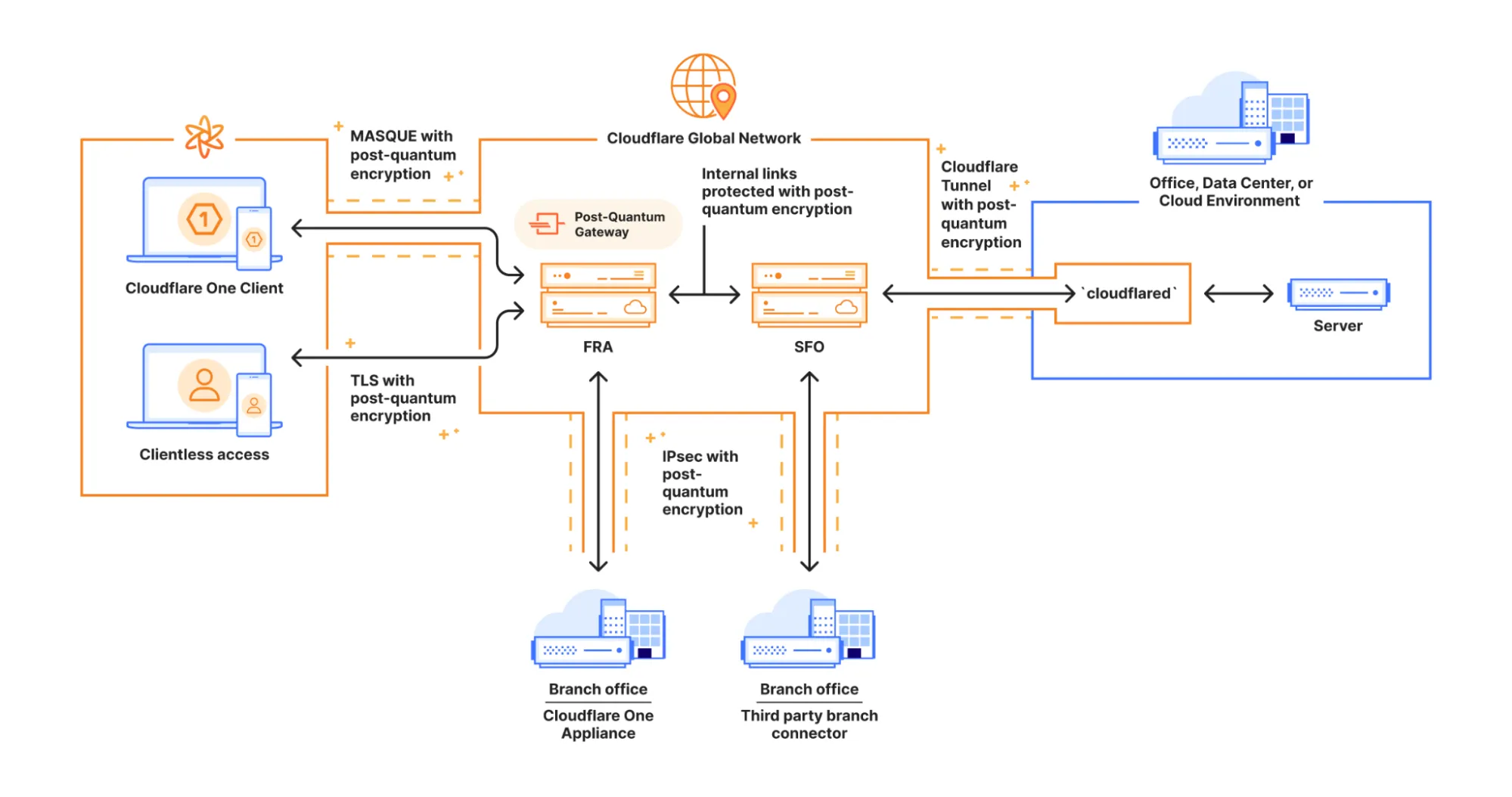
The following sections describe a few network configurations in detail.
You can use Cloudflare Access self-hosted applications in an agentless configuration to protect your organization's Internet traffic to internal web applications. Refer to the learning path for detailed guidance.
Even if the applications themselves have not yet migrated to post-quantum (PQ) cryptography, they will be protected against quantum threats.
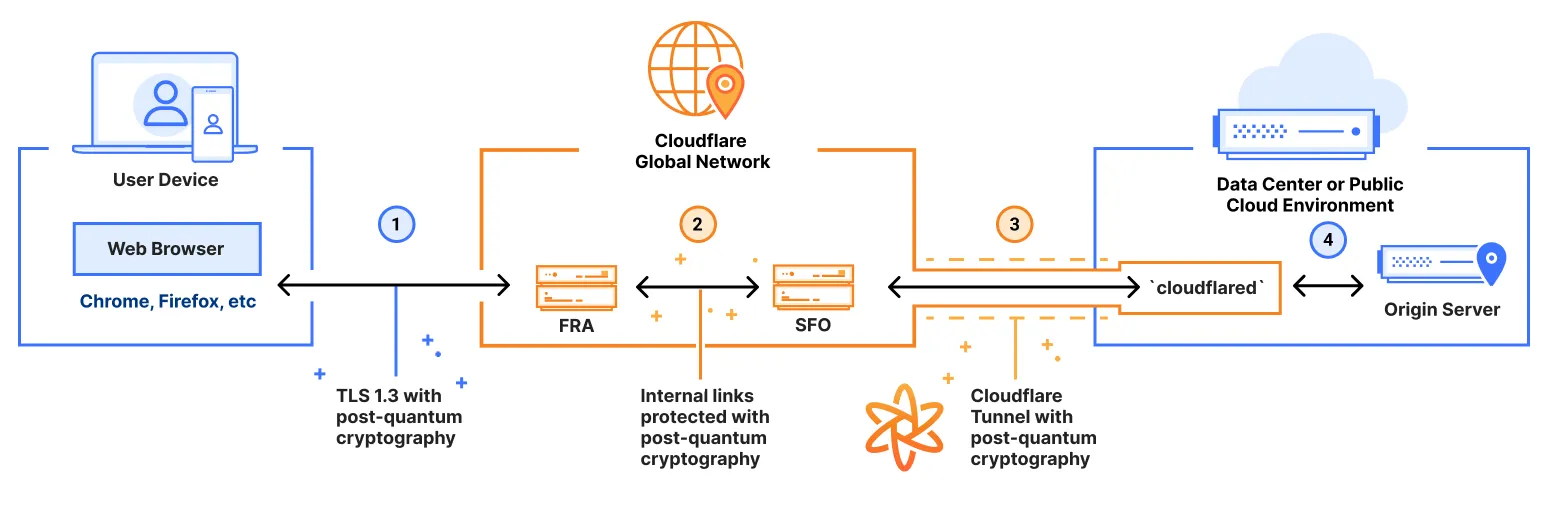
Here is how it works today:
1. PQ connection via browser
As long as the end-user uses a modern web browser that supports post-quantum key agreement (for example, Chrome, Edge, or Firefox), the connection from the device to Cloudflare's network is secured via TLS 1.3 with post-quantum key agreement.
2. PQ within Cloudflare's global network
If the user and origin server are geographically distant, then the user's traffic will enter Cloudflare's global network in one geographic location (such as Frankfurt), and exit at another (such as San Francisco). As this traffic moves from one data center to another inside Cloudflare's global network, these hops through the network are secured via TLS 1.3 with post-quantum key agreement.
3. PQ Cloudflare Tunnel
Customers establish a Cloudflare Tunnel from their data center or public cloud — where their corporate web application is hosted — to Cloudflare's network. This tunnel is secured using TLS 1.3 with post-quantum key agreement, safeguarding it from harvest now, decrypt later attacks ↗.
Putting it together, Cloudflare Access can provide end-to-end quantum safety for accessing corporate HTTPS applications, without requiring customers to upgrade the security of corporate web applications.
Cloudflare One Client (formerly WARP) tunnels traffic over a post-quantum (PQ) MASQUE tunnel using TLS 1.3 with hybrid ML-KEM from the end-user device to Cloudflare's global network. The following is an example network configuration with a Cloudflare One Client on-ramp and a Cloudflare Tunnel off-ramp.
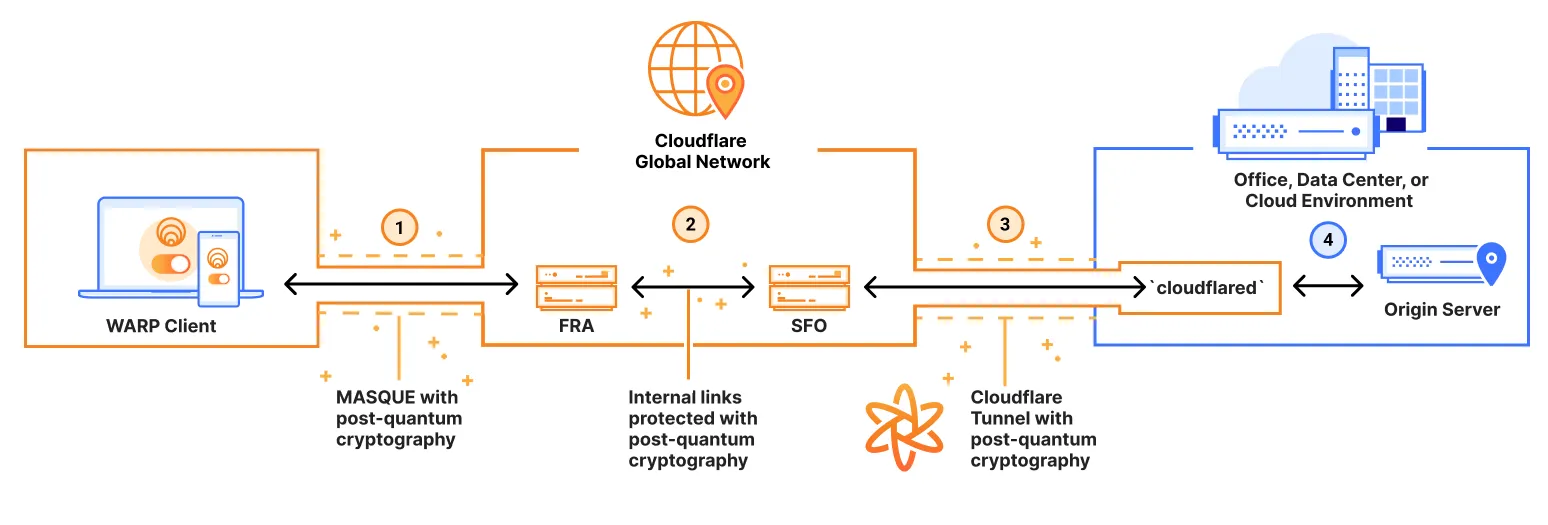
Note: Labels in this image may reflect a previous product name.
1. PQ connection via Cloudflare One Client
The Cloudflare One Client uses the MASQUE protocol to connect from the device to Cloudflare's global network, using TLS 1.3 with hybrid ML-KEM.
2. PQ within Cloudflare's global network
If the user and origin server are geographically distant, then the user's traffic will enter Cloudflare's global network in one geographic location (such as Frankfurt), and exit at another (such as San Francisco). As this traffic moves from one data center to another inside Cloudflare's global network, these hops through the network are secured via TLS 1.3 with post-quantum key agreement.
3. PQ Cloudflare Tunnel
Cloudflare Tunnel already supports post-quantum key agreement.
With this network configuration, traffic is encapsulated in quantum-encrypted tunnels, effectively mitigating the risk of harvest-now, decrypt-later attacks without requiring individual upgrades of networks or applications. This provides comprehensive protection for any protocol that can be sent through these tunnels, not just for HTTPS.
The following is a sample network configuration that uses the Cloudflare One Client on-ramp to connect an end-user device to a server behind a Cloudflare One Appliance off-ramp. Traffic to the server is protected by post-quantum cryptography as it travels over the public Internet, even if the server itself does not support post-quantum cryptography.
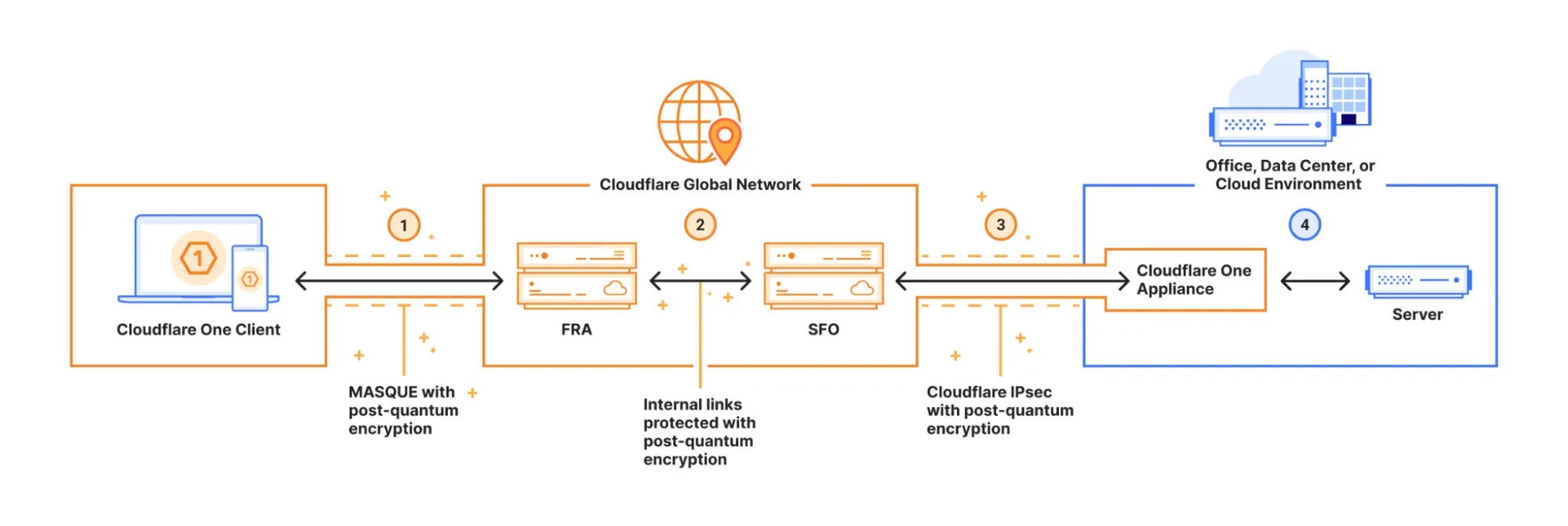
1. PQ connection via Cloudflare One Client
The Cloudflare One Client uses the MASQUE protocol to connect from the device to Cloudflare's global network, using TLS 1.3 with hybrid ML-KEM.
2. PQ within Cloudflare's global network
The traffic then travels across Cloudflare's global network over TLS 1.3 with hybrid ML-KEM.
3. PQ Cloudflare IPsec with Cloudflare One Appliance
Traffic leaves the Cloudflare network over a post-quantum Cloudflare IPsec link that is terminated at a Cloudflare One Appliance. The Cloudflare One Appliance uses a non-IKE keying protocol built into the control plane, secured with TLS, that establishes the keys used to encrypt dataplane traffic in the IPsec ESP protocol. From Appliance version 2026.2.0, the control plane establishes keys over TLS 1.3 protected with hybrid ML-KEM.
A secure web gateway (SWG) ↗ is used to secure access to third-party websites on the public Internet by intercepting and inspecting TLS traffic.
Cloudflare Gateway is now a quantum-safe SWG for HTTPS traffic. As long as the third-party website that is being inspected supports post-quantum key agreement, then Cloudflare's SWG also supports post-quantum key agreement. This is true regardless of the on-ramp that you use to get to Cloudflare's network, and only requires the use of a browser that supports post-quantum key agreement.
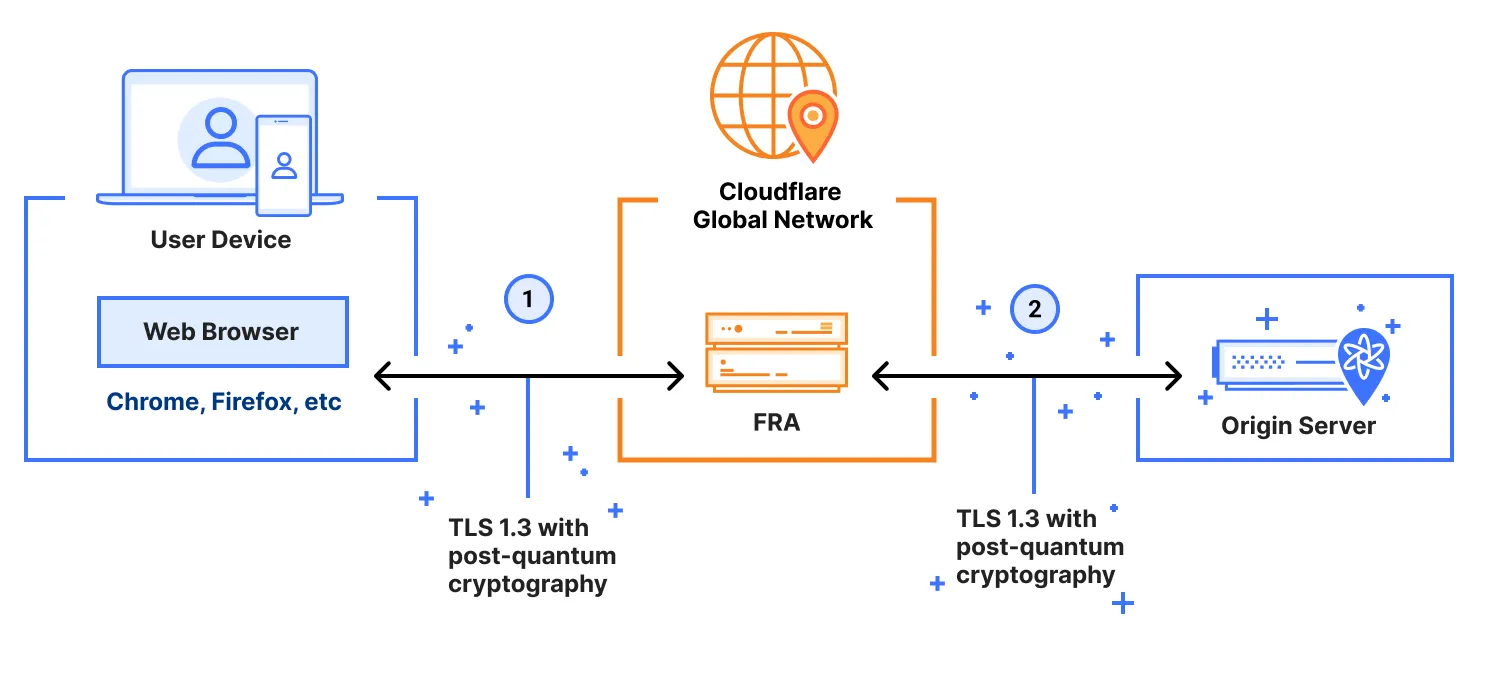
Cloudflare Gateway's HTTPS filtering feature involves two post-quantum TLS connections, as follows:
1. PQ connection via browsers
A TLS connection is initiated from the user's browser to a data center in Cloudflare's network that performs the TLS inspection. As long as the end-user uses a modern web browser that supports post-quantum key agreement (for example, Chrome, Edge, or Firefox), this connection is secured by TLS 1.3 with post-quantum key agreement.
Any traffic that on-ramps to the SWG via the Cloudflare One Client is protected with hybrid ML-KEM, even if the web browser itself does not yet support post-quantum cryptography. This is due to the post-quantum MASQUE tunnel that the Cloudflare One Client establishes to Cloudflare's global network. The same is true of traffic that on-ramps to the SWG using the Cloudflare One Appliance, which establishes a Cloudflare IPsec tunnel protected by post-quantum encryption.
2. PQ connection to the origin server
A TLS connection is initiated from a data center in Cloudflare's network to the origin server, which is typically controlled by a third party. The connection from Cloudflare's SWG currently supports post-quantum key agreement, as long as the third-party's origin server also already supports post-quantum key agreement. You can test this out by using https://pq.cloudflareresearch.com/ ↗ as your third-party origin server.