

You can now enable automatic compaction for Apache Iceberg ↗ tables in R2 Data Catalog to improve query performance.
Compaction is the process of taking a group of small files and combining them into fewer larger files. This is an important maintenance operation as it helps ensure that query performance remains consistent by reducing the number of files that needs to be scanned.
To enable automatic compaction in R2 Data Catalog, find it under R2 Data Catalog in your R2 bucket settings in the dashboard.
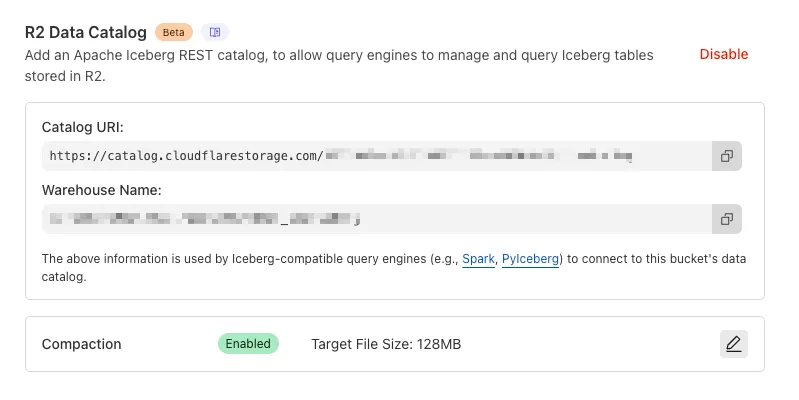
Or with Wrangler, run:
Terminal window npx wrangler r2 bucket catalog compaction enable <BUCKET_NAME> --target-size 128 --token <API_TOKEN>To get started with compaction, check out manage catalogs. For best practices and limitations, refer to about compaction.
This week highlights a critical vendor-specific vulnerability: a deserialization flaw in the License Servlet of Fortra’s GoAnywhere MFT. By forging a license response signature, an attacker can trigger deserialization of arbitrary objects, potentially leading to command injection.
Key Findings
- GoAnywhere MFT (CVE-2025-10035): Deserialization vulnerability in the License Servlet that allows attackers with a forged license response signature to deserialize arbitrary objects, potentially resulting in command injection.
Impact
GoAnywhere MFT (CVE-2025-10035): Exploitation enables attackers to escalate privileges or achieve remote code execution via command injection.
Ruleset Rule ID Legacy Rule ID Description Previous Action New Action Comments Cloudflare Managed Ruleset 100787 Fortra GoAnywhere - Auth Bypass - CVE:CVE-2025-10035 N/A Block This is a New Detection
Email security relies on your submissions to continuously improve our detection models. However, we often receive submissions in formats that cannot be ingested, such as incomplete EMLs, screenshots, or text files.
To ensure all customer feedback is actionable, we have launched two new features to manage invalid submissions sent to our team and user submission aliases:
- Email Notifications: We now automatically notify users by email when they provide an invalid submission, educating them on the correct format. To disable notifications, go to Settings ↗ > Invalid submission emails and turn the feature off.

- Invalid Submission dashboard: You can quickly identify which users need education to provide valid submissions so Cloudflare can provide continuous protection.
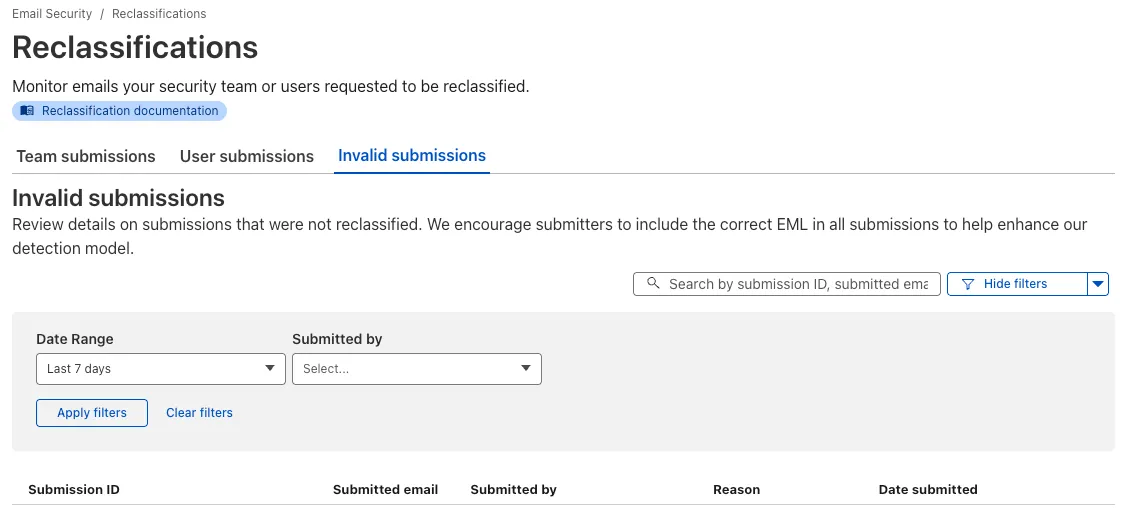
Learn more about this feature on invalid submissions.
This feature is available across these Email security packages:
- Advantage
- Enterprise
- Enterprise + PhishGuard
You can run multiple Workers in a single dev command by passing multiple config files to
wrangler dev:Terminal window wrangler dev --config ./web/wrangler.jsonc --config ./api/wrangler.jsoncPreviously, if you ran the command above and then also ran wrangler dev for a different Worker, the Workers running in separate wrangler dev sessions could not communicate with each other. This prevented you from being able to use Service Bindings ↗ and Tail Workers ↗ in local development, when running separate wrangler dev sessions.
Now, the following works as expected:
Terminal window # Terminal 1: Run your application that includes both Web and API workerswrangler dev --config ./web/wrangler.jsonc --config ./api/wrangler.jsonc# Terminal 2: Run your auth worker separatelywrangler dev --config ./auth/wrangler.jsoncThese Workers can now communicate with each other across separate dev commands, regardless of your development setup.
./api/src/index.ts export default {async fetch(request, env) {// This service binding call now works across dev commandsconst authorized = await env.AUTH.isAuthorized(request);if (!authorized) {return new Response('Unauthorized', { status: 401 });}return new Response('Hello from API Worker!', { status: 200 });},};Check out the Developing with multiple Workers guide to learn more about the different approaches and when to use each one.
Browser-based RDP with Cloudflare Access is now generally available for all Cloudflare customers. It enables secure, remote Windows server access without VPNs or RDP clients.
Since we announced our open beta, we've made a few improvements:
- Support for targets with IPv6.
- Support for Magic WAN and WARP Connector as on-ramps.
- More robust error messaging on the login page to help you if you encounter an issue.
- Worldwide keyboard support. Whether your day-to-day is in Portuguese, Chinese, or something in between, your browser-based RDP experience will look and feel exactly like you are using a desktop RDP client.
- Cleaned up some other miscellaneous issues, including but not limited to enhanced support for Entra ID accounts and support for usernames with spaces, quotes, and special characters.
As a refresher, here are some benefits browser-based RDP provides:
- Control how users authenticate to internal RDP resources with single sign-on (SSO), multi-factor authentication (MFA), and granular access policies.
- Record who is accessing which servers and when to support regulatory compliance requirements and to gain greater visibility in the event of a security event.
- Eliminate the need to install and manage software on user devices. You will only need a web browser.
- Reduce your attack surface by keeping your RDP servers off the public Internet and protecting them from common threats like credential stuffing or brute-force attacks.
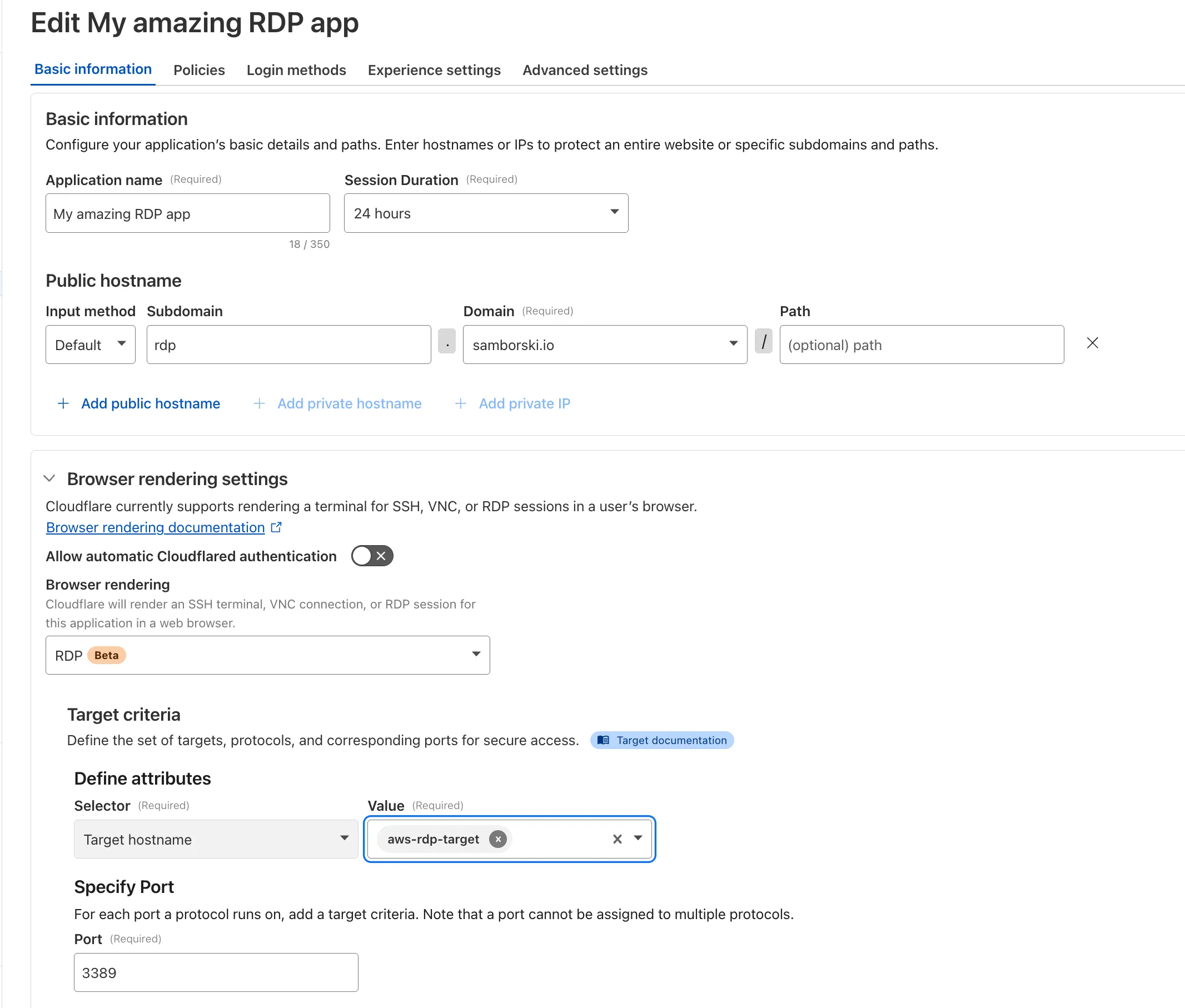
To get started, refer to Connect to RDP in a browser.
This week emphasizes two critical vendor-specific vulnerabilities: a full elevation-of-privilege in Microsoft Azure Networking (CVE-2025-54914) and a server-side template injection (SSTI) leading to remote code execution (RCE) in Skyvern (CVE-2025-49619). These are complemented by enhancements in generic detections (SQLi, SSRF) to improve baseline coverage.
Key Findings
-
Azure (CVE-2025-54914): Vulnerability in Azure Networking allowing elevation of privileges.
-
Skyvern (CVE-2025-49619): Skyvern ≤ 0.1.85 has a server-side template injection (SSTI) vulnerability in its Prompt field (workflow blocks) via Jinja2. Authenticated users with low privileges can get remote code execution (blind).
-
Generic SQLi / SSRF improvements: Expanded rule coverage to detect obfuscated SQL injection patterns and SSRF across host, local, and cloud contexts.
Impact
These vulnerabilities allow attackers to escalate privileges or execute code under conditions where previously they could not:
-
Azure CVE-2025-54914 enables an attacker from the network with no credentials to gain high-level access within Azure Networking; could lead to full compromise of networking components.
-
Skyvern CVE-2025-49619 allows authenticated users with minimal privilege to exploit SSTI for remote code execution, undermining isolation of workflow components.
-
The improvements for SQLi and SSRF reduce risk from common injection and request-based attacks.
Ruleset Rule ID Legacy Rule ID Description Previous Action New Action Comments Cloudflare Managed Ruleset 100146 SSRF - Host - 2 Log Disabled This is a New Detection Cloudflare Managed Ruleset 100146B SSRF - Local - 2 Log Disabled This is a New Detection Cloudflare Managed Ruleset 100146C SSRF - Cloud - 2 Log Disabled This is a New Detection Cloudflare Managed Ruleset 100714 Azure - Auth Bypass - CVE:CVE-2025-54914 Log Block This is a New Detection Cloudflare Managed Ruleset 100758 Skyvern - Remote Code Execution - CVE:CVE-2025-49619 Log Block This is a New Detection Cloudflare Managed Ruleset 100773 Next.js - SSRF Log Block This is a New Detection Cloudflare Managed Ruleset 100774 Adobe Commerce - Remote Code Execution - CVE:CVE-2025-54236 Log Block This is a New Detection Cloudflare Managed Ruleset 100800_BETA SQLi - Obfuscated Boolean - Beta Log Block This rule has been merged into the original rule (ID: -
AutoRAG now includes a Metrics tab that shows how your data is indexed and searched. Get a clear view of the health of your indexing pipeline, compare usage between
ai-searchandsearch, and see which files are retrieved most often.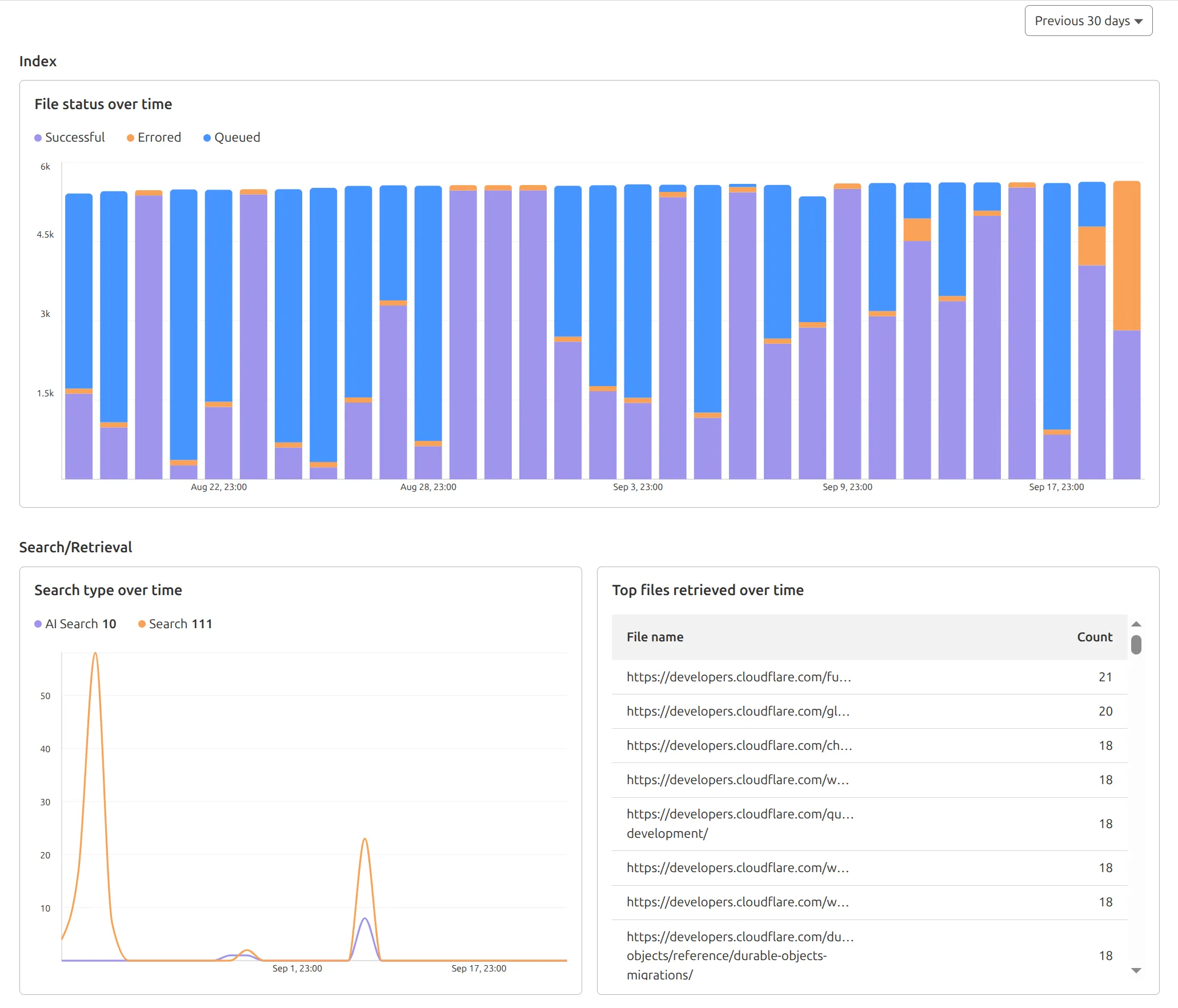
You can find these metrics within each AutoRAG instance:
- Indexing: Track how files are ingested and see status changes over time.
- Search breakdown: Compare usage between
ai-searchandsearchendpoints. - Top file retrievals: Identify which files are most frequently retrieved in a given period.
Try it today in AutoRAG.
Rate Limiting within Cloudflare Workers is now Generally Available (GA).
The
ratelimitbinding is now stable and recommended for all production workloads. Existing deployments using the unsafe binding will continue to function to allow for a smooth transition.For more details, refer to Workers Rate Limiting documentation.
In workers-rs ↗, Rust panics were previously non-recoverable. A panic would put the Worker into an invalid state, and further function calls could result in memory overflows or exceptions.
Now, when a panic occurs, in-flight requests will throw 500 errors, but the Worker will automatically and instantly recover for future requests.
This ensures more reliable deployments. Automatic panic recovery is enabled for all new workers-rs deployments as of version 0.6.5, with no configuration required.
Rust Workers are built with Wasm Bindgen, which treats panics as non-recoverable. After a panic, the entire Wasm application is considered to be in an invalid state.
We now attach a default panic handler in Rust:
std::panic::set_hook(Box::new(move |panic_info| {hook_impl(panic_info);}));Which is registered by default in the JS initialization:
JavaScript import { setPanicHook } from "./index.js";setPanicHook(function (err) {console.error("Panic handler!", err);});When a panic occurs, we reset the Wasm state to revert the Wasm application to how it was when the application started.
We worked upstream on the Wasm Bindgen project to implement a new
--experimental-reset-state-functioncompilation option ↗ which outputs a new__wbg_reset_statefunction.This function clears all internal state related to the Wasm VM, and updates all function bindings in place to reference the new WebAssembly instance.
One other necessary change here was associating Wasm-created JS objects with an instance identity. If a JS object created by an earlier instance is then passed into a new instance later on, a new "stale object" error is specially thrown when using this feature.
Building on this new Wasm Bindgen feature, layered with our new default panic handler, we also added a proxy wrapper to ensure all top-level exported class instantiations (such as for Rust Durable Objects) are tracked and fully reinitialized when resetting the Wasm instance. This was necessary because the workerd runtime will instantiate exported classes, which would then be associated with the Wasm instance.
This approach now provides full panic recovery for Rust Workers on subsequent requests.
Of course, we never want panics, but when they do happen they are isolated and can be investigated further from the error logs - avoiding broader service disruption.
In the future, full support for recoverable panics could be implemented without needing reinitialization at all, utilizing the WebAssembly Exception Handling ↗ proposal, part of the newly announced WebAssembly 3.0 ↗ specification. This would allow unwinding panics as normal JS errors, and concurrent requests would no longer fail.
We're making significant improvements to the reliability of Rust Workers ↗. Join us in
#rust-on-workerson the Cloudflare Developers Discord ↗ to stay updated.
You can now route private traffic to Cloudflare Tunnel based on a hostname or domain, moving beyond the limitations of IP-based routing. This new capability is free for all Cloudflare One customers.
Previously, Tunnel routes could only be defined by IP address or CIDR range. This created a challenge for modern applications with dynamic or ephemeral IP addresses, often forcing administrators to maintain complex and brittle IP lists.
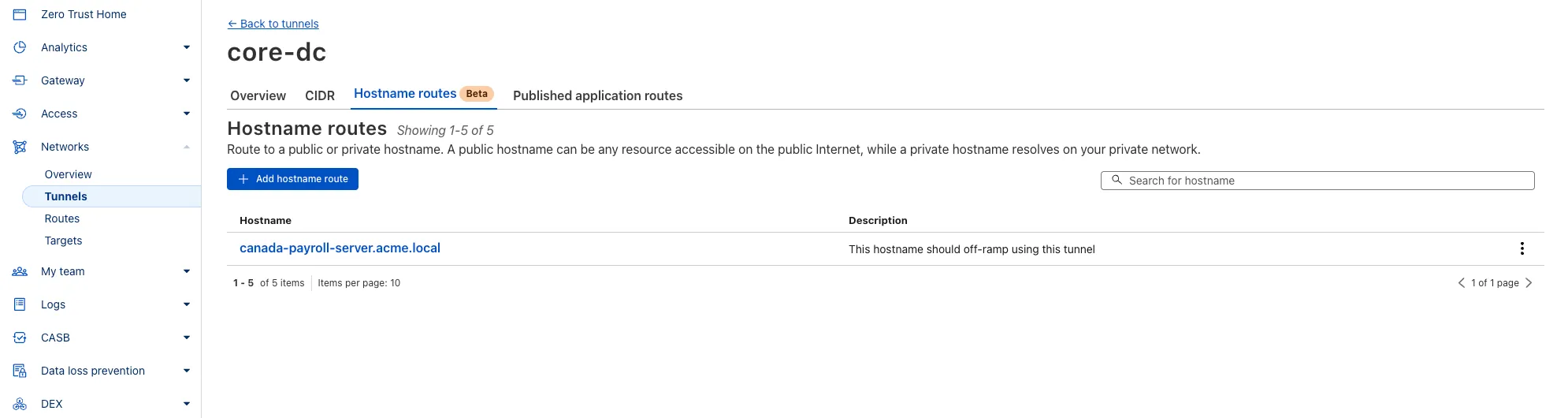
What’s new:
- Hostname & Domain Routing: Create routes for individual hostnames (e.g.,
payroll.acme.local) or entire domains (e.g.,*.acme.local) and direct their traffic to a specific Tunnel. - Simplified Zero Trust Policies: Build resilient policies in Cloudflare Access and Gateway using stable hostnames, making it dramatically easier to apply per-resource authorization for your private applications.
- Precise Egress Control: Route traffic for public hostnames (e.g.,
bank.example.com) through a specific Tunnel to enforce a dedicated source IP, solving the IP allowlist problem for third-party services. - No More IP Lists: This feature makes the workaround of maintaining dynamic IP Lists for Tunnel connections obsolete.
Get started in the Tunnels section of the Zero Trust dashboard with your first private hostname or public hostname route.
Learn more in our blog post ↗.
- Hostname & Domain Routing: Create routes for individual hostnames (e.g.,
We recently increased the available disk space from 8 GB to 20 GB for all plans. Building on that improvement, we’re now doubling the CPU power available for paid plans — from 2 vCPU to 4 vCPU.
These changes continue our focus on making Workers Builds faster and more reliable.
Metric Free Plan Paid Plans CPU 2 vCPU 4 vCPU - Fast build times: Even single-threaded workloads benefit from having more vCPUs
- 2x faster multi-threaded builds: Tools like esbuild ↗ and webpack ↗ can now utilize additional cores, delivering near-linear performance scaling
All other build limits — including memory, build minutes, and timeout remain unchanged.
To prevent the accidental exposure of applications, we've updated how Worker preview URLs (
<PREVIEW>-<WORKER_NAME>.<SUBDOMAIN>.workers.dev) are handled. We made this change to ensure preview URLs are only active when intentionally configured, improving the default security posture of your Workers.We performed a one-time update to disable preview URLs for existing Workers where the workers.dev subdomain was also disabled.
Because preview URLs were historically enabled by default, users who had intentionally disabled their workers.dev route may not have realized their Worker was still accessible at a separate preview URL. This update was performed to ensure that using a preview URL is always an intentional, opt-in choice.
If your Worker was affected, its preview URL (
<PREVIEW>-<WORKER_NAME>.<SUBDOMAIN>.workers.dev) will now direct to an informational page explaining this change.How to Re-enable Your Preview URL
If your preview URL was disabled, you can re-enable it via the Cloudflare dashboard by navigating to your Worker's Settings page and toggling on the Preview URL.
Alternatively, you can use Wrangler by adding the
preview_urls = truesetting to your Wrangler file and redeploying the Worker.JSONC {"preview_urls": true}TOML preview_urls = trueNote: You can set
preview_urls = truewith any Wrangler version that supports the preview URL flag (v3.91.0+). However, we recommend updating to v4.34.0 or newer, as this version defaultspreview_urlsto false, ensuring preview URLs are always enabled by explicit choice.
Zero Trust Dashboard has a brand new, AI-powered search functionality. You can search your account by resources (applications, policies, device profiles, settings, etc.), pages, products, and more.
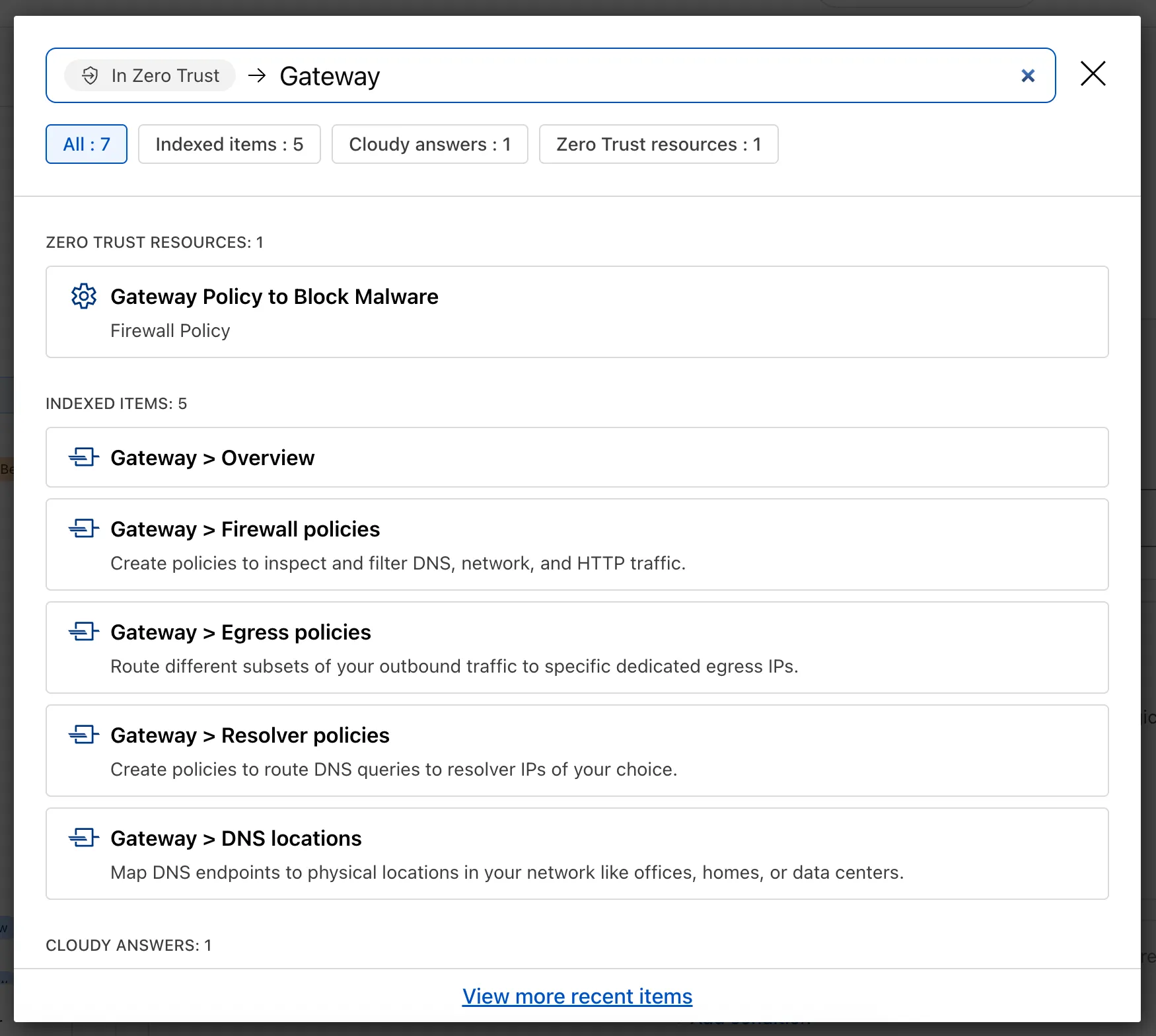
Ask Cloudy — You can also ask Cloudy, our AI agent, questions about Cloudflare Zero Trust. Cloudy is trained on our developer documentation and implementation guides, so it can tell you how to configure functionality, best practices, and can make recommendations.
Cloudy can then stay open with you as you move between pages to build configuration or answer more questions.
Find Recents — Recent searches and Cloudy questions also have a new tab under Zero Trust Overview.
-
Access GraphQL-powered DNS Firewall analytics directly in the Cloudflare dashboard.
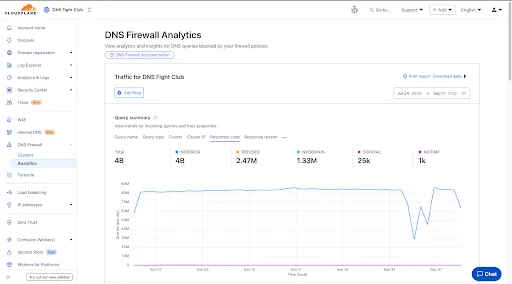
- Query summary: Describes trends over time, segmented by dimensions.
- Query statistics: Describes totals, cached/uncached queries, and processing/response times.
- DNS queries by data center: Describes global view and the top 10 data centers.
- Top query statistics: Shows a breakdown by key dimensions, with search and expand options (up to top 100 items).
Additional features:
- Apply filters and time ranges once. Changes reflect across all panels.
- Filter by dimensions like query name, query type, cluster, data center, protocol (UDP/TCP), IP version, response code/reason, and more.
- Access up to 62 days of historical data with flexible intervals.
Available to all DNS Firewall customers as part of their existing subscription.
-
In the Cloudflare dashboard, go to the DNS Firewall page.
Go to Analytics -
Refer to the DNS Firewall Analytics to learn more.
Three months ago we announced the public beta of remote bindings for local development. Now, we're excited to say that it's available for everyone in Wrangler, Vite, and Vitest without using an experimental flag!
With remote bindings, you can now connect to deployed resources like R2 buckets and D1 databases while running Worker code on your local machine. This means you can test your local code changes against real data and services, without the overhead of deploying for each iteration.
To enable remote bindings, add
"remote" : trueto each binding that you want to rely on a remote resource running on Cloudflare:JSONC {"name": "my-worker",// Set this to today's date"compatibility_date": "2026-04-04","r2_buckets": [{"bucket_name": "screenshots-bucket","binding": "screenshots_bucket","remote": true,},],}TOML name = "my-worker"# Set this to today's datecompatibility_date = "2026-04-04"[[r2_buckets]]bucket_name = "screenshots-bucket"binding = "screenshots_bucket"remote = trueWhen remote bindings are configured, your Worker still executes locally, but all binding calls are proxied to the deployed resource that runs on Cloudflare's network.
You can try out remote bindings for local development today with:
This week's update
This week's focus highlights newly disclosed vulnerabilities in DevOps tooling, data visualization platforms, and enterprise CMS solutions. These issues include sensitive information disclosure and remote code execution, putting organizations at risk of credential leakage, unauthorized access, and full system compromise.
Key Findings
-
Argo CD (CVE-2025-55190): Exposure of sensitive information could allow attackers to access credential data stored in configurations, potentially leading to compromise of Kubernetes workloads and secrets.
-
DataEase (CVE-2025-57773): Insufficient input validation enables JNDI injection and insecure deserialization, resulting in remote code execution (RCE). Successful exploitation grants attackers control over the application server.
-
Sitecore (CVE-2025-53694): A sensitive information disclosure flaw allows unauthorized access to confidential information stored in Sitecore deployments, raising the risk of data breaches and privilege escalation.
Impact
These vulnerabilities expose organizations to serious risks, including credential theft, unauthorized access, and full system compromise. Argo CD's flaw may expose Kubernetes secrets, DataEase exploitation could give attackers remote execution capabilities, and Sitecore's disclosure issue increases the likelihood of sensitive data leakage and business impact.
Administrators are strongly advised to apply vendor patches immediately, rotate exposed credentials, and review access controls to mitigate these risks.
Ruleset Rule ID Legacy Rule ID Description Previous Action New Action Comments Cloudflare Managed Ruleset 100646 Argo CD - Information Disclosure - CVE:CVE-2025-55190s Log Disabled This is a New Detection Cloudflare Managed Ruleset 100874 DataEase - JNDI injection - CVE:CVE-2025-57773 Log Disabled This is a New Detection Cloudflare Managed Ruleset 100880 Sitecore - Information Disclosure - CVE:CVE-2025-53694 Log Block This is a New Detection -
We’re excited to announce that Email security customers can now choose their preferred mail processing location directly from the UI when onboarding a domain. This feature is available for the following onboarding methods: MX, BCC, and Journaling.
Customers can now select where their email is processed. The following regions are supported:
- Germany
- India
- Australia
Global processing remains the default option, providing flexibility to meet both compliance requirements or operational preferences.
When onboarding a domain with MX, BCC, or Journaling:
- Select the desired processing location (Germany, India, or Australia).
- The UI will display updated processing addresses specific to that region.
- For MX onboarding, if your domain is managed by Cloudflare, you can automatically update MX records directly from the UI.
This feature is available across these Email security packages:
- Advantage
- Enterprise
- Enterprise + PhishGuard
We’re expanding the list of processing locations to match our Data Localization Suite (DLS) footprint, giving customers the broadest set of regional options in the market without the complexity of self-hosting.
D1 now detects read-only queries and automatically attempts up to two retries to execute those queries in the event of failures with retryable errors. You can access the number of execution attempts in the returned response metadata property
total_attempts.At the moment, only read-only queries are retried, that is, queries containing only the following SQLite keywords:
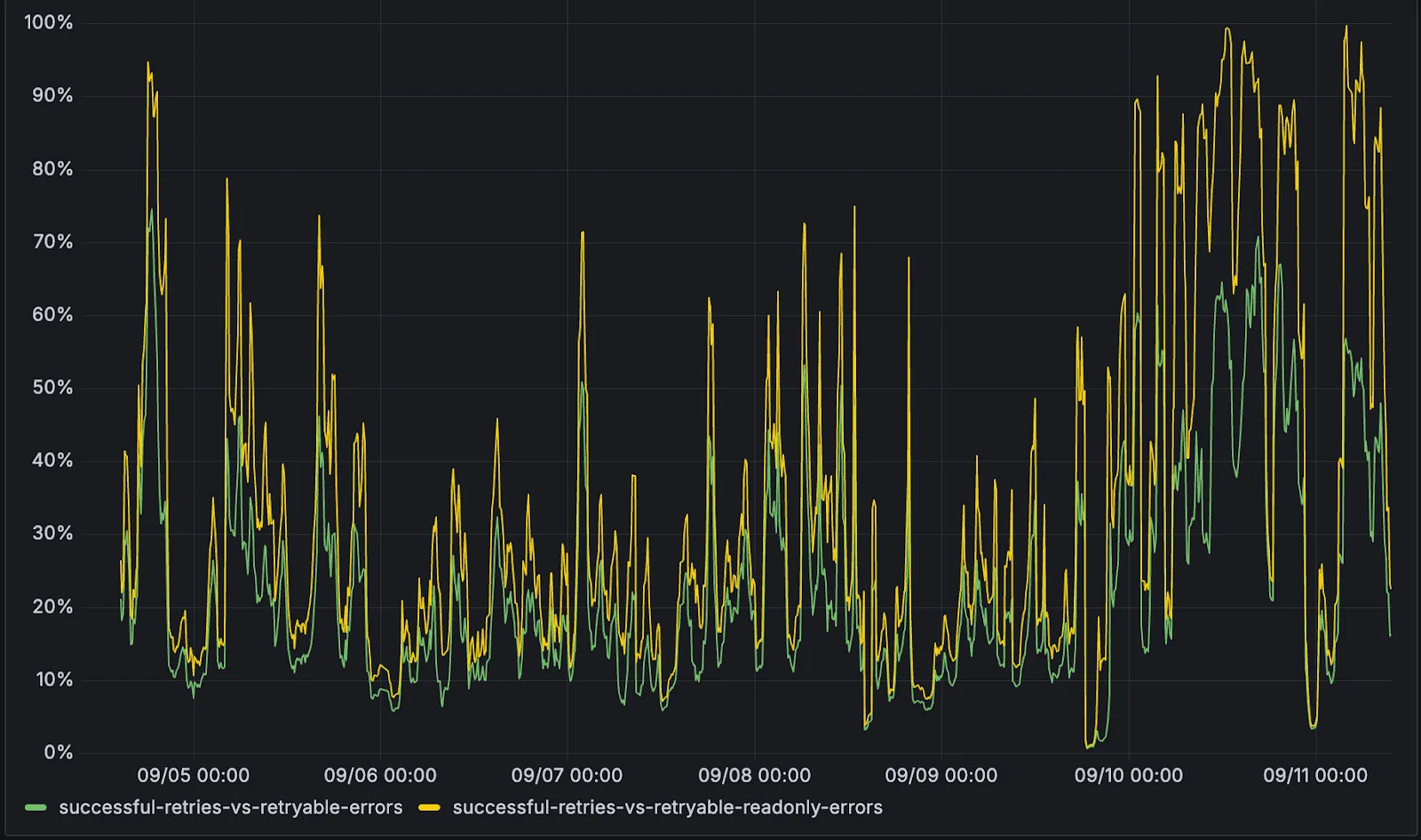
SELECT,EXPLAIN,WITH. Queries containing any SQLite keyword ↗ that leads to database writes are not retried.The retry success ratio among read-only retryable errors varies from 5% all the way up to 95%, depending on the underlying error and its duration (like network errors or other internal errors).
The retry success ratio among all retryable errors is lower, indicating that there are write-queries that could be retried. Therefore, we recommend D1 users to continue applying retries in their own code for queries that are not read-only but are idempotent according to the business logic of the application.
D1 ensures that any retry attempt does not cause database writes, making the automatic retries safe from side-effects, even if a query causing changes slips through the read-only detection. D1 achieves this by checking for modifications after every query execution, and if any write occurred due to a retry attempt, the query is rolled back.
The read-only query detection heuristics are simple for now, and there is room for improvement to capture more cases of queries that can be retried, so this is just the beginning.
Magic WAN and WARP Connector users can now securely route their DNS traffic to the Gateway resolver without exposing traffic to the public Internet.
Routing DNS traffic to the Gateway resolver allows DNS resolution and filtering for traffic coming from private networks while preserving source internal IP visibility. This ensures Magic WAN users have full integration with our Cloudflare One features, including Internal DNS and hostname-based policies.
To configure DNS filtering, change your Magic WAN or WARP Connector DNS settings to use Cloudflare's shared resolver IPs,
172.64.36.1and172.64.36.2. Once you configure DNS resolution and filtering, you can use Source Internal IP as a traffic selector in your resolver policies for routing private DNS traffic to your Internal DNS.
Directly from Log Search results, customers can pivot to other parts of the Cloudflare dashboard to immediately take action as a result of their investigation.
From the
http_requestsorfw_eventsdataset results, right click on an IP Address or JA3 Fingerprint to pivot to the Investigate portal to lookup the reputation of an IP address or JA3 fingerprint.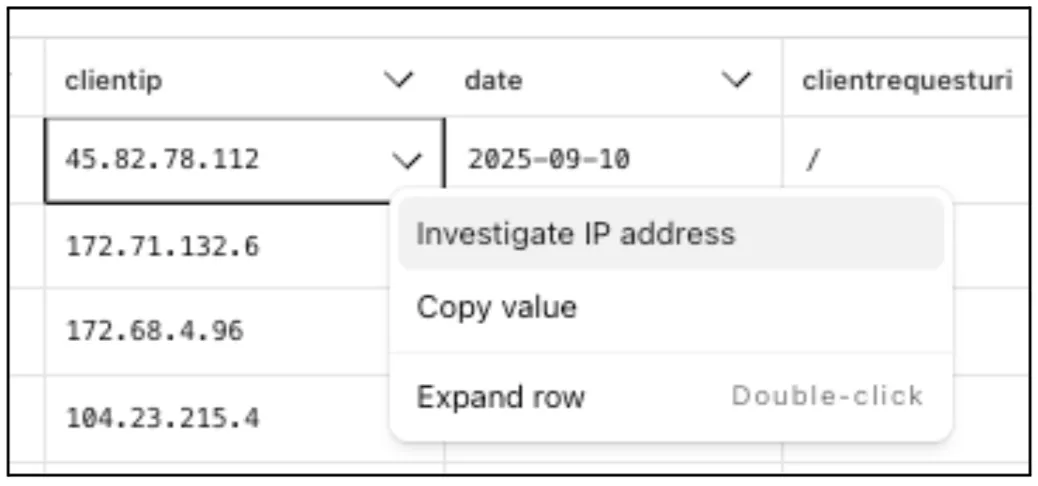
Easily learn about error codes by linking directly to our documentation from the EdgeResponseStatus or OriginResponseStatus fields.
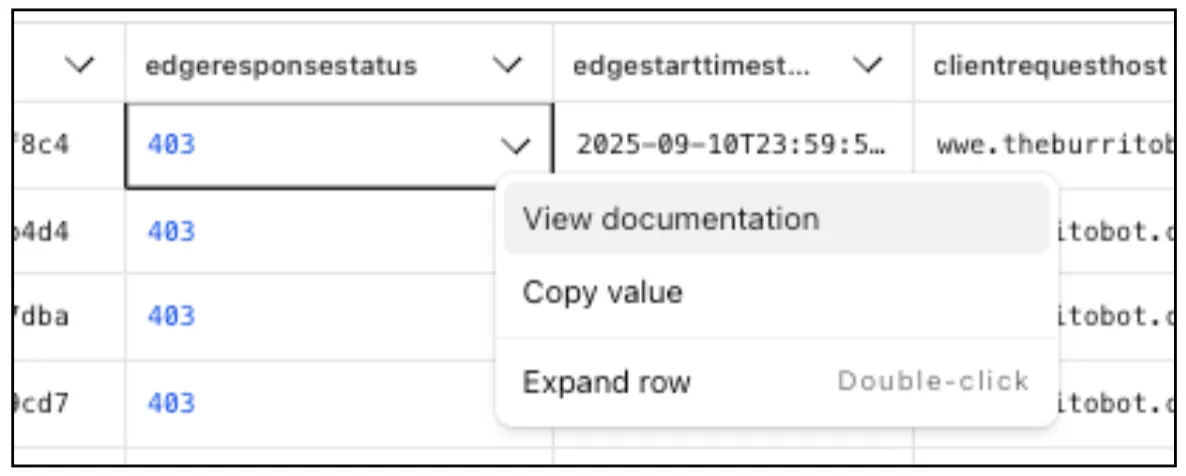
From the
gateway_httpdataset, click on a policyid to link directly to the Zero Trust dashboard to review or make changes to a specific Gateway policy.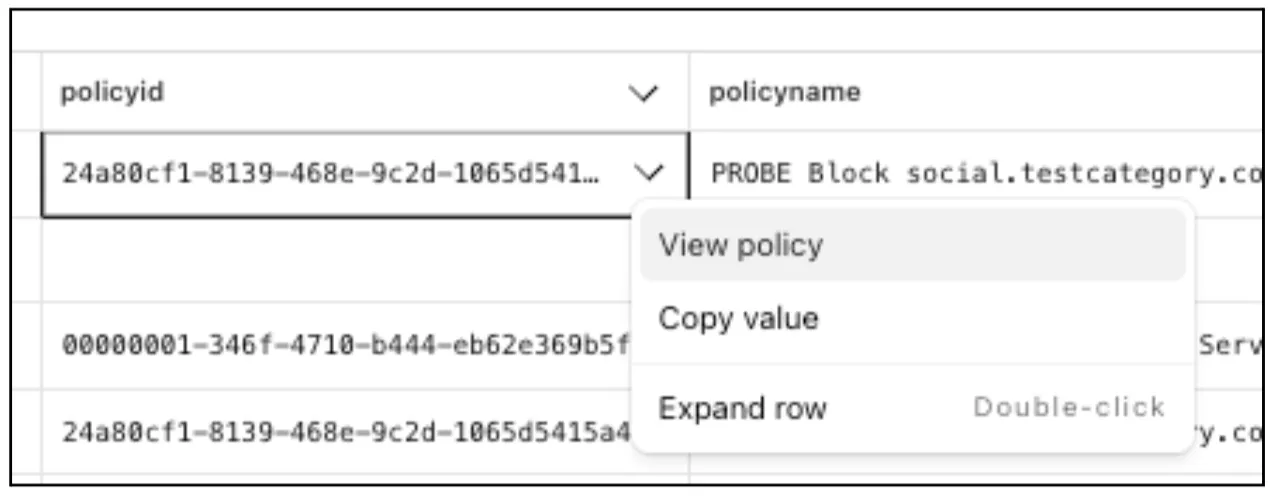
The results table view of Log Search has been updated with additional functionality and a more streamlined user experience. Users can now easily:
- Remove/add columns.
- Resize columns.
- Sort columns.
- Copy values from any field.

The number of recent versions available for a Worker rollback has been increased from 10 to 100.
This allows you to:
-
Promote any of the 100 most recent versions to be the active deployment.
-
Split traffic using gradual deployments between your latest code and any of the 100 most recent versions.
You can do this through the Cloudflare dashboard or with Wrangler's rollback command
Learn more about versioned deployments and rollbacks.
-
A new Beta release for the Windows WARP client is now available on the beta releases downloads page.
This release contains minor fixes and improvements including enhancements to Proxy mode for even faster resolution. The MASQUE protocol is now the only protocol that can use Proxy mode. If you previously configured a device profile to use Proxy mode with Wireguard, you will need to select a new WARP mode or all devices matching the profile will lose connectivity.
Changes and improvements
- Enhancements to Proxy mode for even faster resolution. The MASQUE protocol is now the only protocol that can use Proxy mode. If you previously configured a device profile to use Proxy mode with Wireguard, you will need to select a new WARP mode or all devices matching the profile will lose connectivity.
- Improvement to keep TCP connections up the first time WARP connects on devices so that remote desktop sessions (such as RDP or SSH) continue to work.
- Improvements to maintain Global WARP Override settings when switching between organization configurations.
- The MASQUE protocol is now the default protocol for all new WARP device profiles.
- Improvement to limit idle connections in DoH mode to avoid unnecessary resource usage that can lead to DoH requests not resolving.
Known issues
For Windows 11 24H2 users, Microsoft has confirmed a regression that may lead to performance issues like mouse lag, audio cracking, or other slowdowns. Cloudflare recommends users experiencing these issues upgrade to a minimum Windows 11 24H2 KB5062553 or higher for resolution.
Devices using WARP client 2025.4.929.0 and up may experience Local Domain Fallback failures if a fallback server has not been configured. To configure a fallback server, refer to Route traffic to fallback server.
Devices with KB5055523 installed may receive a warning about Win32/ClickFix.ABA being present in the installer. To resolve this false positive, update Microsoft Security Intelligence to version 1.429.19.0 or later.
DNS resolution may be broken when the following conditions are all true:
- WARP is in Secure Web Gateway without DNS filtering (tunnel-only) mode.
- A custom DNS server address is configured on the primary network adapter.
- The custom DNS server address on the primary network adapter is changed while WARP is connected.
To work around this issue, reconnect the WARP client by toggling off and back on.
A new Beta release for the macOS WARP client is now available on the beta releases downloads page.
This release contains minor fixes and improvements including enhancements to Proxy mode for even faster resolution. The MASQUE protocol is now the only protocol that can use Proxy mode. If you previously configured a device profile to use Proxy mode with Wireguard, you will need to select a new WARP mode or all devices matching the profile will lose connectivity.
Changes and improvements
- Enhancements to Proxy mode for even faster resolution. The MASQUE protocol is now the only protocol that can use Proxy mode. If you previously configured a device profile to use Proxy mode with Wireguard, you will need to select a new WARP mode or all devices matching the profile will lose connectivity.
- Fixed a bug preventing the
warp-diag captive-portalcommand from running successfully due to the client not parsing SSID on macOS. - Improvements to maintain Global WARP Override settings when switching between organization configurations.
- The MASQUE protocol is now the default protocol for all new WARP device profiles.
- Improvement to limit idle connections in DoH mode to avoid unnecessary resource usage that can lead to DoH requests not resolving.
Known issues
- macOS Sequoia: Due to changes Apple introduced in macOS 15.0.x, the WARP client may not behave as expected. Cloudflare recommends the use of macOS 15.4 or later.
- Devices using WARP client 2025.4.929.0 and up may experience Local Domain Fallback failures if a fallback server has not been configured. To configure a fallback server, refer to Route traffic to fallback server.
We've shipped a new release for the Agents SDK ↗ bringing full compatibility with AI SDK v5 ↗ and introducing automatic message migration that handles all legacy formats transparently.
This release includes improved streaming and tool support, tool confirmation detection (for "human in the loop" systems), enhanced React hooks with automatic tool resolution, improved error handling for streaming responses, and seamless migration utilities that work behind the scenes.
This makes it ideal for building production AI chat interfaces with Cloudflare Workers AI models, agent workflows, human-in-the-loop systems, or any application requiring reliable message handling across SDK versions — all while maintaining backward compatibility.
Additionally, we've updated workers-ai-provider v2.0.0, the official provider for Cloudflare Workers AI models, to be compatible with AI SDK v5.
Creates a new chat interface with enhanced v5 capabilities.
TypeScript // Basic chat setupconst { messages, sendMessage, addToolResult } = useAgentChat({agent,experimental_automaticToolResolution: true,tools,});// With custom tool confirmationconst chat = useAgentChat({agent,experimental_automaticToolResolution: true,toolsRequiringConfirmation: ["dangerousOperation"],});Tools are automatically categorized based on their configuration:
TypeScript const tools = {// Auto-executes (has execute function)getLocalTime: {description: "Get current local time",inputSchema: z.object({}),execute: async () => new Date().toLocaleString(),},// Requires confirmation (no execute function)deleteFile: {description: "Delete a file from the system",inputSchema: z.object({filename: z.string(),}),},// Server-executed (no client confirmation)analyzeData: {description: "Analyze dataset on server",inputSchema: z.object({ data: z.array(z.number()) }),serverExecuted: true,},} satisfies Record<string, AITool>;Send messages using the new v5 format with parts array:
TypeScript // Text messagesendMessage({role: "user",parts: [{ type: "text", text: "Hello, assistant!" }],});// Multi-part message with filesendMessage({role: "user",parts: [{ type: "text", text: "Analyze this image:" },{ type: "image", image: imageData },],});Simplified logic for detecting pending tool confirmations:
TypeScript const pendingToolCallConfirmation = messages.some((m) =>m.parts?.some((part) => isToolUIPart(part) && part.state === "input-available",),);// Handle tool confirmationif (pendingToolCallConfirmation) {await addToolResult({toolCallId: part.toolCallId,tool: getToolName(part),output: "User approved the action",});}Seamlessly handle legacy message formats without code changes.
TypeScript // All these formats are automatically converted:// Legacy v4 string contentconst legacyMessage = {role: "user",content: "Hello world",};// Legacy v4 with tool callsconst legacyWithTools = {role: "assistant",content: "",toolInvocations: [{toolCallId: "123",toolName: "weather",args: { city: "SF" },state: "result",result: "Sunny, 72°F",},],};// Automatically becomes v5 format:// {// role: "assistant",// parts: [{// type: "tool-call",// toolCallId: "123",// toolName: "weather",// args: { city: "SF" },// state: "result",// result: "Sunny, 72°F"// }]// }Migrate tool definitions to use the new
inputSchemaproperty.TypeScript // Before (AI SDK v4)const tools = {weather: {description: "Get weather information",parameters: z.object({city: z.string(),}),execute: async (args) => {return await getWeather(args.city);},},};// After (AI SDK v5)const tools = {weather: {description: "Get weather information",inputSchema: z.object({city: z.string(),}),execute: async (args) => {return await getWeather(args.city);},},};Seamless integration with Cloudflare Workers AI models through the updated workers-ai-provider v2.0.0.
Use Cloudflare Workers AI models directly in your agent workflows:
TypeScript import { createWorkersAI } from "workers-ai-provider";import { useAgentChat } from "agents/ai-react";// Create Workers AI model (v2.0.0 - same API, enhanced v5 internals)const model = createWorkersAI({binding: env.AI,})("@cf/meta/llama-3.2-3b-instruct");Workers AI models now support v5 file handling with automatic conversion:
TypeScript // Send images and files to Workers AI modelssendMessage({role: "user",parts: [{ type: "text", text: "Analyze this image:" },{type: "file",data: imageBuffer,mediaType: "image/jpeg",},],});// Workers AI provider automatically converts to proper formatEnhanced streaming support with automatic warning detection:
TypeScript // Streaming with Workers AI modelsconst result = await streamText({model: createWorkersAI({ binding: env.AI })("@cf/meta/llama-3.2-3b-instruct"),messages,onChunk: (chunk) => {// Enhanced streaming with warning handlingconsole.log(chunk);},});Update your imports to use the new v5 types:
TypeScript // Before (AI SDK v4)import type { Message } from "ai";import { useChat } from "ai/react";// After (AI SDK v5)import type { UIMessage } from "ai";// or alias for compatibilityimport type { UIMessage as Message } from "ai";import { useChat } from "@ai-sdk/react";- Migration Guide ↗ - Comprehensive migration documentation
- AI SDK v5 Documentation ↗ - Official AI SDK migration guide
- An Example PR showing the migration from AI SDK v4 to v5 ↗
- GitHub Issues ↗ - Report bugs or request features
We'd love your feedback! We're particularly interested in feedback on:
- Migration experience - How smooth was the upgrade process?
- Tool confirmation workflow - Does the new automatic detection work as expected?
- Message format handling - Any edge cases with legacy message conversion?